
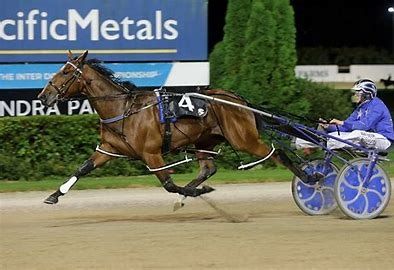
It’s that time of year. Sales week and all the attendant drama, triumphs and disappointments, records and retreats, game changers and tall stories.
So naturally it is a focus week for the Kiwi King of the Ring, Mark Purdon, the most successful buyer of them all. Though itt not like it used to be.
“Yes I will be lining up again in Auckland at least but my main job is done looking over the horses in both islands and that is the hard part. I have been over Nathan’s list and pared it back a bit to fit the budget as he is not on the scale we once were and you wouldn’t expect he would be. I will probably leave Christchurch bidding to him unless he wants me there”
But the skills and intuitions that brought about those golden hours in the selling ring for more than two decades are still valuable. So is the magic formula ?
That is always a difficult question for proven great judges. Firstly there is the old-fashioned trade secrets built up over many years. But also those in the genius category as judges of horseflesh often don’t know for sure themselves how they compute the last two points out of 10 that makes them label a horse a a “must have” It is born with experience and topped with skill and intuition.
Q It starts with the pedigree. You have a great knowledge of bloodlines which must be valuable. But have you ever bought a horse just on its breeding ?
Mark :Starts with the catalogue though much of it is the process of elimination to come up with a realistic list. There are several important steps after that. I think the closest I came to buying just on pedigree was Have Faith In Me. He wasn’t a very impressive yearling but the family was flying and he wasn’t in strong demand. Turned out to be much better than he looked. But that was unusual for me.
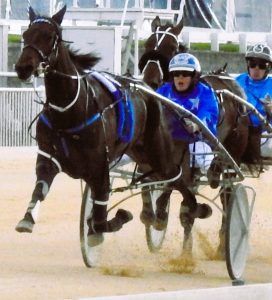
Have Faith In Me launches in NZ Cup Trial. A pedigree buy
Q What are those most important steps ?
Mark: Well you inspect them,sometimes more than once and see if the looks match the book. I always found it valuable to talk to those preparing them. Just to get a background on them, get a feel for their attitude and ease of handling. It can confirm what you are thinking or cause you to have another look. It can make the difference between the “would like” horse and the “must have”
Q The perfect horse is hard to find. What apparent flaws in the physical makeup are you prepared to discount in the overall picture ?
Mark: Knees probably. Being back at the knee or offset at that stage I could overlook as long as they turn to the inside (outside pointed more likely to touch a knee when pacing) I found that these days faults can catch up with them earlier than in past eras. I guess it’s because they are finer bred and come earlier than they used to and maybe because there is much more earlier age racing. So if you are buying for the commercial market you can’t take the risks you would be prepared to do as a hobby buyer and owner.
Q You concentrate on type where you want an early return Do they always turn out as they look ?
Mark: We had to look at it from that angle. There was often big money paid and the owners were going to get a bill at the end of the month so the emphasis was on an early return. Developing four year olds was not the option. Most of ours were doing it at two or early three year olds so we concentrated on getting that part right. But no, you cannot always tell how quickly they will develop. Many live up to their promise. Some are still developing 12 months later,; some just don’t develop at all.12 months later they look like they did the day you bought them. Fortunately not too many, but a few.
Q I know you always had a price formula so owners were not carrying too much risk but you had to go big sometimes. Did your buys ever actually top the sales ?
Mark: I think Jesse Duke,whom I bought with Jean Feiss may have and possibly Don’t Stop Dreaming. Just not sure about that. Jean would have a list and we would go over it and make the final decision together. Don’t Stop Dreaming I initially priced much below his market appeal and it was touch and go whether we would get him. Of course a lot of the top lots disappoint but that’s why you have to assess them so carefully and then hope for the best.
Q So a lot of bargains, and Lazarus under $100,000 possibly the greatest. Do you have any other special memory of bargain buys ?
Mark: Lazarus was first sighted by Phil (Kennard) who was starting to do inspections himself and asked me what I thought. I was with him and it was probably a “must have” after that. He turned out a steal alright. Follow the Stars was a cheap buy. He was a great little horse who presented like an early comer and more than lived up to it.I bought him mostly on type. Likemesiah was a cheap horse too and a real star in that era. We had quite a lot of luck with reasonably priced horses especially in earlier years when we had less to spend.
Q No doubt Bettor’s Delight was a boon for you in stallion selection as he has been for everyone. Did you have a distinct preference for proven stallions when assessing a yearling ? The stats suggest you did.
Mark: Most of ours were in that category but I was prepared to take a chance on a first season sire if I liked the type. Likemesiah was an early Christian Cullen and some I was keen to take on lesser or unproven sires for breeders like Auckland Reactor. I bought the Lazarus horse now racing well for Bob Butt in Laz’s unproven days. You lean toward the proven but you have to keep an open mind. Having too many strong views is not always a good thing dealing with yearlings.
Q Was Il Vicolo,your first star, one of your buys ?
Mark: No I think Gary Hillier takes the credit there. He was training two horses for John whom I had met a few times up north and got on well with and then he rang up out of the blue and told me Gary was giving up training and would I like a share in one of them to train both. That was Il Vicolo. The other one wasn’t much good. So it was still a dream start for us the way things turned out.
Q Was Smolda one horse you could say in the circumstances you bought on intuition ?
Mark: Not really because we did like him before the sale. But I had my heart set on Fly Like an Eagle and I was thinking he would fetch $80,000 which was all of our budget so others were out of the question. As it happened we got him for $35,000. Then Neil (Pilcher) heard Smolda had been sold on a disputed bid and was coming back into the ring.We got him for $55,000. It seemed as if it was meant to be and a great stroke of luck. Getting two like that on the same day was something to remember.I think Smolda may have been the last one fully syndicated too after one partner dropped out. They quinellaed the Derby.
Q Often overlooked is the fact that the vital time for yearlings with ability is their development and training and you came into your own there. Did you prefer to handle them immediately and get them used to the environment or did they go straight to the breaker ?
Mark: When Natalie and I were in partnership we shared a lot in the compiling of buying lists and also later. She was a great person to have backing you. They usually had a little time off before going to the breaker.
But what we found was that when we were buying bigger numbers sending them to the breakers all at once didn’t bring the results. The breakers needed more time with them than the numbers would allow. The results deteriorated but it wasn’t that the breakers weren’t doing what they could. So Nat and I would divide them in three groups to go the breaker at different times and that worked out well.
After that the training and the driving was the key of course. A horse can’t do it on ability alone.
Q You spent many years gaining experience at yearling buying.What do you rate your biggest lesson ?
Mark: For quite a few years we had limited budgets and you never stopped learning. There is always something to pick up in experience even now. My biggest lesson was probably in ring presentation. I remember one preparer produced these lovely big rounded well bred types that really caught my eye. But they all turned out very disappointing, soft sorts whose condition fell away when you trained them. They were overfed and probably under exercised. I took a while to wake up to that. It was a valuable lesson and changed my thinking when assessing them.
Q What about “copycat” bidders. You must have had a few given your success. Did you have to take steps against them?
Mark: Actually a well known racing personality was the first.He’d come to life as soon as I started bidding. There were others we were aware of. They could send your costs up a lot. We did spread it around a bit but my main action was with the spot bidders. They would call “Bid!” and point to the buyer so when it was me the cat was out of the bag. I prevailed on them to take the bid without that fanfare and watch for my nod instead of raising a hand etc. That helped but it is something you have to live with too.
Q From my own experience I realise what actually very hard work a day looking at yearlings is. You find that ?
Mark: Yes it’s the hardest part and something I wouldn’t miss. The worst is that when you are finished you go home and go through your notes and comparisons and that takes nearly as long. Always glad when that’s over
PS Pantani is Nathan’s only runner tonight. He puts it very well
“Couldn’t be working better.Just have to hold our breath for 1700m”